
Compliance Engine for PLM
A compliance service for FMCG products: it checks ingredients, claims and category classification against Indian food-safety (FSSAI) regulations, combining deterministic rule logic with LLM reasoning to return traceable findings.
- ownership
- Architected and built the core
- when
- 2026
- org
- Bettrlabs
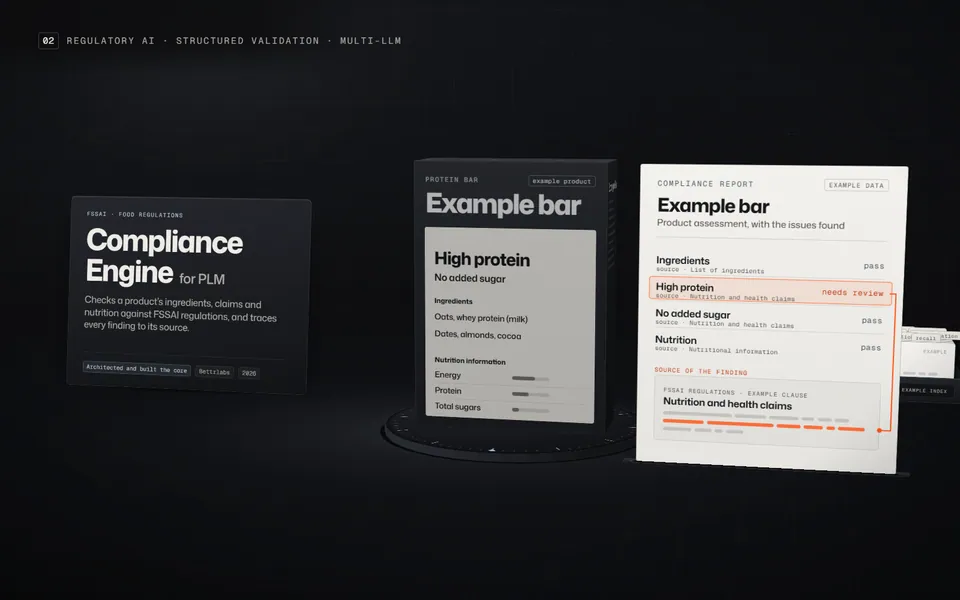
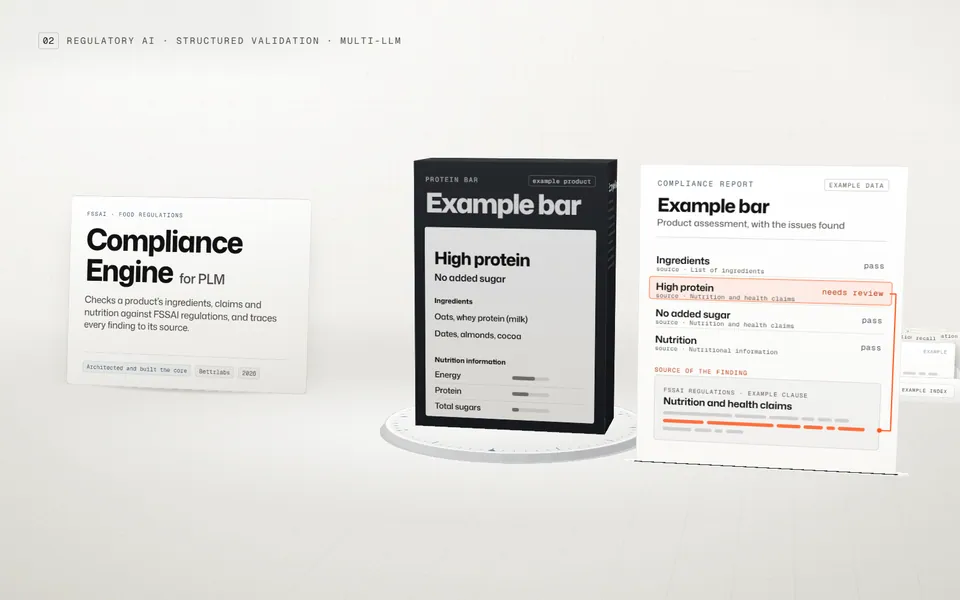
The film, as text: Compliance Engine for PLM. A compliance service for FMCG products: it checks ingredients, claims and category classification against Indian food-safety (FSSAI) regulations, combining deterministic rule logic with LLM reasoning to return traceable findings. Three kinds of data: A product is read as three kinds of data: ingredients, claims and nutrition. Regulatory RAG: Each field is matched with the regulations that apply to it. Structured validation: Structured rule checks validate every field against the retrieved requirements. LLM council: Several models review each finding independently, and their results are cross-validated. Traceable report: Every finding in the report links back to its source. Architected and built the core, Bettrlabs, 2026.
Problem.
Compliance is not prompt in, report out. Every finding has to cite its regulation, and results must stay accurate, traceable and cheap to run at production scale.
How it works
- AI architecture: designed the service end to end, deciding where deterministic rule logic decides and where an LLM reasons, so each check runs on the cheapest reliable path.
- Full compliance check: ingredients, claims, nutrition and product category classification are validated against FSSAI regulations, using regulatory RAG and structured rule checks together.
- Accuracy at low token cost: prompt optimisation, compact structured context and structured outputs keep accuracy high while token usage stays low.
- Multi-LLM council: several models cross-validate findings before they reach the report, so results are more reliable than a single model response.
- Traceable reports: a compliance report and product assessment itemise every issue with the regulation behind it.
- Data and backend: designed the database and knowledge-graph data layer, and took part in building the backend that serves the service inside the PLM platform on labs.new.
Stack
- AI architecture
- LLM reasoning with rule logic
- Regulatory RAG
- Multi-LLM council
- Structured outputs
- Prompt optimization
- Token optimization
- Compliance logic
- Ingredient checks
- Claim validation
- Category classification
- FSSAI rule engine
- Traceable findings
- Data
- Database design
- Knowledge graph
- PostgreSQL
- Application
- Python
- FastAPI
- React
- Next.js
- Tailwind CSS